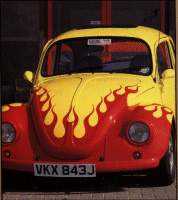

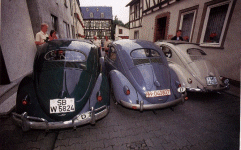
Such is the enduring appeal and ingenious simplicity of the Volkswagen Beetle that the vehicle, which was originally designed to provide low-cost working-class mobility in pre-war Ger-many, can be found. 50 years later, all over the world and decorated in colours and driven at speeds undreamed of by the car's designers.
The Beetle has passed its 50th birthday, and is still being produced in fac-tories in both Mexico and Brazil; production ceased for a while in Brazil, but was restarted re-cently when the government identified the need for an affordable small car and provided tax breaks for the company. Over 21 million Beetles have been manufactured since production started, and since 1972, when it overtook the Ford Model T, the Beetle has been the most-produced single car model in history - it has even been voted the Car of the Century.

The world's most popular car, which is so full of character that most owners endow them with nicknames, was born in the dark days of Nazi Germany. It was part of Hitler's dream to produce a car for the masses - a Volkswagen or "People's Car" - which the average German family could afford.
The designer of the Beetle was Ferdinand Porsche, who had designed his first car at the age of 21 and who had worked for most of the great names in pre-war German automotive manufac-turing such as Lohner, Austro-Daimler, Mer-cedes, Daimler-Benz and Steyr, before opening his own design bureau in 1930. At least ten years earlier Porsche had designed a small, affordable car for Daimler, but the project halted at the pro-totype stage. In 1931 he set his staff to designing a vehicle which featured a lightweight three-cylinder radial engine, with fully independent suspension and was able to transport four adults in comfort at 100 kph (62 mph). The price was to be kept at a sufficiently low level to make it affordable to the masses.
Porsche tried to sell his idea to the German motor industry; initially the motorcycle manu-facturer Zundapp, was interested, although the project was cancelled largely due to the uncertain economic climate in Germany at the time, and was subsequently taken up by NSU, another motorcycle manufacturer wishing to expand. However, although three prototypes of the NSU car were constructed, the project was aban-doned.
Top of the page